1. What is renewable energy marketing, and why is it important?
Renewable energy marketing is the process of promoting your clean energy solutions (solar, wind, hydrogen, etc.) in a way that educates stakeholders, builds trust, accelerates adoption, and maximizes profit.
Unlike traditional marketing, it involves simplifying complex technologies, overcoming skepticism, and aligning with global sustainability goals, which makes it more than just selling a product.
For example:
- Simplify technical terms like LCOE (Levelized Cost of Energy) or perovskite solar into investor and customer-friendly language.
- Build credibility by using certifications, transparent data, and case studies to prove reliability.
- Align with global agendas by connecting your brand messaging to the UN SDGs or EU Green Deal to attract ESG investors.
- Earn local trust by showing real-world benefits to surrounding communities, not just abstract climate goals.
Why renewable energy marketing is important:
The global renewable energy market is projected to grow to over $2.1 trillion in the next decade due to changes in energy consumption (IEA report, 2024)
Companies that communicate clearly and credibly achieve faster adoption, stronger investor confidence, and a larger share of this fast-growing market.
2. How does marketing help renewable energy companies grow faster?
Marketing helps renewable energy companies grow faster by creating awareness, shortening long sales cycles, generating qualified leads, and positioning them as trusted leaders in a crowded market.
Deals in clean energy often take months or even years to close. That’s why visibility, trust, and consistency matter.
In renewable energy, buyers rarely act on the first touch. Success comes from creating a multichannel ecosystem where every interaction reinforces credibility until they’re ready to commit.
Effective marketing ensures your brand stays top of mind with decision-makers, reinforcing your value at every stage of your buyer’s journey.
Here’s how:
- Stay visible: Through SEO, AI, and targeted campaigns. With these campaigns, your brand solution will remain top of mind to investors and customers even during long evaluation periods.
- Educate early: Content and webinars answer questions before they’re asked. This removes friction from the buying process.
- Reinforce trust: Case studies, certifications, and clear ROI projections help your potential customers justify multimillion-dollar investments.
Putting all this into practice, logotio.agency partnered with a cleantech brand and increased brand awareness by 61 percent in just six months, resulting into 10x return on investment.
The real shift didn’t come from simply running ads or posting content.
It came from aligning a strategic, cohesive brand presence with AI-optimized content and targeted campaigns; all built around a consistent message that spoke directly to their audience.
You can read the full case study here.
Marketing isn’t about chasing impressions or clicks.
When its done strategically, it becomes a growth engine that positions your clean energy company as the obvious choice in a fast-growing, competitive market.
3. What makes marketing for renewable energy different from other industries?
Renewable energy marketing is different because you need to balance technical credibility, regulatory awareness, and emotional storytelling all at once.
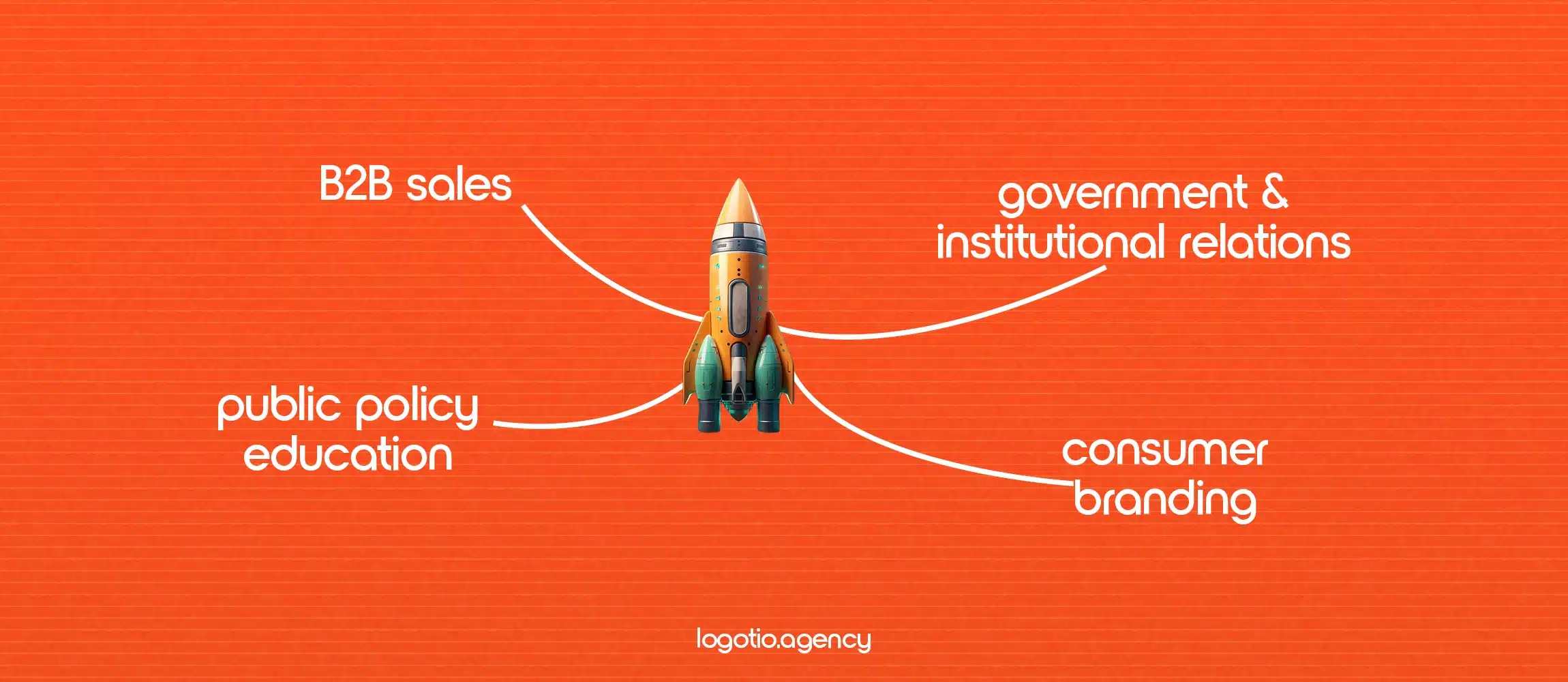
Renewable energy marketing is a hybrid discipline that blends B2B sales, government and institutional relations, public policy education, and consumer branding. Brands that master all four angles scale faster.
In most industries, marketing focuses on quick conversions.
In renewable energy, you’re speaking to:
- Policymakers and regulators who demand compliance and technical rigor.
- Investors who want proof of ROI, scale, and ESG alignment.
- Consumers who care about cost savings, independence, and climate impact.
That’s why clean energy marketing often includes:
- Complex content (like LCOE) breakdowns, technical white papers, and compliance proofs.
- Extended sales cycles measured in months or years, not days or weeks.
- Trust signals such as certifications, lifecycle performance data, and third-party validations.
Here’s a quick comparison between traditional marketing and renewable energy marketing:
| Factor | Traditional Marketing | Renewable Energy Marketing |
|---|---|---|
| Target Audience | Mostly consumers/B2B | Investors, policymakers, government institutions, corporates, homeowners |
| Sales Cycle | Days or weeks | Months or years |
| Trust Signals | Brand loyalty and reviews | Certifications (like UL, ISO 14001), independent audits, case studies |
| Content Style | Benefits + educational storytelling content | Technical + Educational + Emotional storytelling content. |
4. What role does branding play in attracting clean-energy investors?
Branding de-risks your company for investors: clear positioning, credible case studies, and consistent presentation reduce perceived risk, shorten diligence, and raise your “investability” in a tougher funding market.
Why branding is so important
- Capital is selective. Climate-tech financing fell approximately 29% across the most recent four quarters measured by PwC. This implies that only the clearest, most credible equity stories get funded.
- Investors expect proof, not slogans. McKinsey notes that investors want explicit links between ESG strategy and business value; your brand must surface those proof points (unit economics, pipeline, certifications) in seconds.
Beyond investors, strong branding has ripple effects:
- It builds trust with clients and stakeholders.
- It creates easier recognition, both for clients and the wider public.
- The stronger the brand, the higher the willingness to pay, which directly improves margins.
- And when buyers or investors compare 2–3 similar offers, branding often becomes the final decision-maker, shaping where the gut feeling points.
5. Who is the target audience for renewable-energy solutions?
The target audience for renewable-energy solutions are three main groups: buyers/operators, end customers/communities, and investors.
Each requires a different equity story, proof, and call-to-action (CTA).
The segmentation that actually drives deals is shown in the table below:
| Segment | Example | What they need (value story) | Convention (proof) | CTA |
|---|---|---|---|---|
| Enterprises, B2B | EPC Director, Operations Lead | Lower LCOE/TCO, reliability, interconnection risk mitigation, delivery timelines | MW deployed, fleet availability, bankability studies, warranties. | Book a technical walkthrough |
| Public Sector, Communities | City energy office, NGOs, cooperatives | Jobs, resilience, environmental benefits, grants | Community impact metrics, IRA/Grant navigation, resilience KPIs | Request funding roadmap |
| Residential | Homeowners, individuals | Monthly savings, backup power, installer quality | Before/after bills, NPS, equipment specs, permits passed | Instant quote |
| Investors | Partners, Investment Directors | Defensible moat, pipeline quality, unit economics, path to scale | Cohort margins, CAC:LTV, contracts/MOUs, certifications | Access data |
Why this segmentation works:
B2B buyers prefer a self-directed, proof-led journey. Decision makers are triggered by high-quality thought leadership and practical resources drive consideration.
Evidence (proof):
Decision-makers credit strong thought leadership with prompting product research and shaping vendor lists.
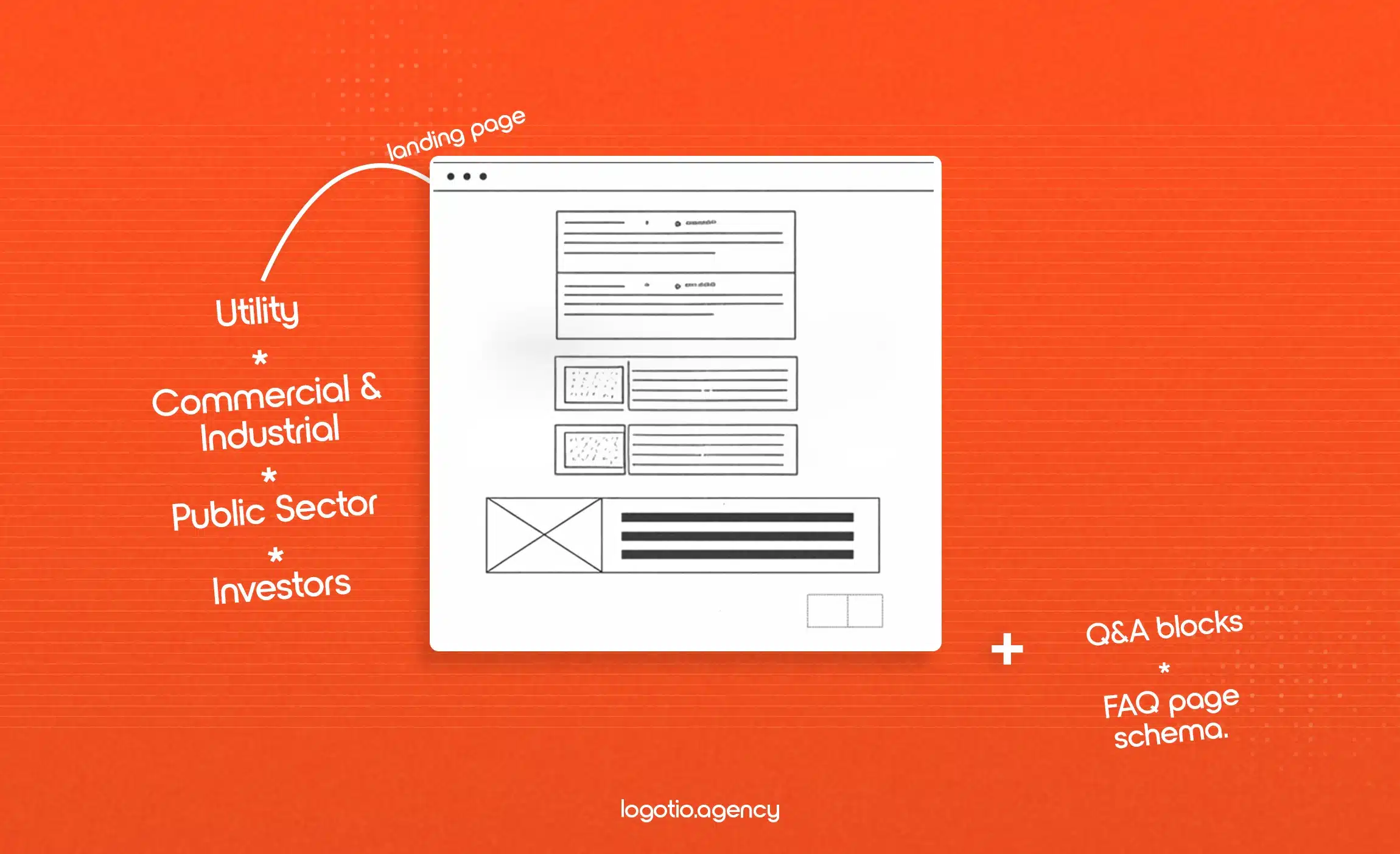
Google’s helpful-content/EEAT guidance (Experience, Expertise, Authoritativeness, and Trustworthiness) favors clear, people-first pages (e.g., role-specific landing pages + FAQs).
6. How do you identify and address customer pain points in the clean energy sector?
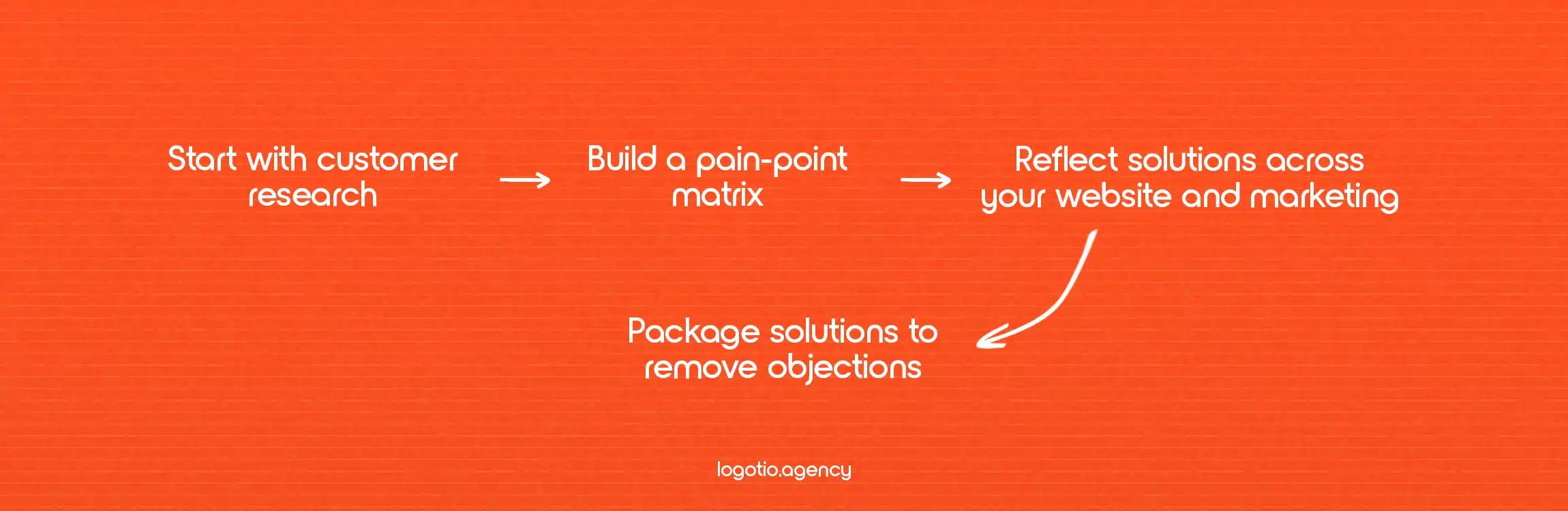
Start by interviewing recent buyers of green energy products, mapping their decision journey, and packaging solutions (financing, proof, guarantees) that remove their recurring objections and blocks.
Then, reflect those answers in your website architecture, pricing pages, sales enablement and content marketing.
Here’s how to go about it:
Research: Interview 10–15 buyers, review CRM win/loss notes, support tickets, and competitor reviews.
Turn your findings into a Pain-Point Matrix (pain point frequency and impact).
Implement: State this in your website and content through:
- Intellectual arguments that mirror your buyers’ journey (problem, proof, plan, price, decision).
- Value propositions that communicate what you offer, your proof, and why you are their best choice.
- Sales pages aligned to each persona (Utility, Commercial & Industrial, Public Sector, and Investors).
7. What actually motivates people to invest or switch to renewable energy?
These three drivers always motivate investment or a switch to clean energy solutions: compelling economics (predictable savings), reduced risk/exposure (price volatility and reliability), and credible ESG impact, delivered with your solution proof.
Let’s break it down by segment:
Businesses & Public Sector: Total cost of ownership, hedging against energy price swings, green procurement wins, and asset valuation benefits (e.g., higher LEED/BREEAM scores).
Investors: Bankable tech, clear unit economics (LCOE vs. grid), defensible moat, and policy tailwinds.
Households/Small & Medium Businesses: Bill stability, resilience (storage/backup), incentives/rebates, and trusted installer reputation.
High-leverage messaging tips:
- Lead with numbers over adjectives.
- Tie to energy security and long-term cost control, not just “green” claims.
- Localize incentives, interconnection timelines, and utility policies on geo-targeted pages.
- Show before/after utility bills and production vs. consumption charts from real systems.
This works because buyers respond to demonstrable outcomes; cost control, reliability, and mission fit over generic “sustainability” copy.
8. Which digital channels work best for renewable energy right now?
For B2B/enterprise and high-consideration sales, the most reliable mixture is SEO + AIO (AI Overviews visibility) + LinkedIn + well-orchestrated PPC, then email to nurture and recycle demand.
AIO / GEO (AI Overviews):
Structure your website content so AI systems can understand and cite your brand. Use clean hierarchy, FAQs, schema where applicable, sources, and author bylines.
Google’s AI Overviews has changed the display of the SERP (search engine results page) by making it the first result in almost all search queries.
SEO (Search Engine Optimization):
Build topical authority with evergreen. commercial-intent content and internal linking. You can check Google’s starter guidance for fundamentals and page experience.
LinkedIn:
This helps you get in touch with economic buyers through thought leadership, case snippet carousels, and event promotions. Retarget site engagers with BOFU (bottom-of-funnel) assets/content.
Edelman LinkedIn research shows that decision-makers reward high-quality thought leadership.
PPC (speed & precision):
Use Google Ads for high-intent queries you currently don’t rank for.
Use paid social for account lists (ABM — account-based marketing), webinar signups, and retargeting.
9. How do you optimize a renewable energy website for SEO without fluff?
Get obsessed with crawlability, speed, clarity, and topical depth, then map your content to commercial intent and local SEO if you operate and offer services in a specific location.
SEO is categorized into three types: on-page, technical, and off-page SEO.
You can read our practical guide on how to optimize your renewable energy website professionally.
10. Why bother optimizing for GEO/AIO (AI search) if we already do SEO?
There is a need to optimize for AI search also known as answer engine optimization because AI overviews and assistants summarize answers to web users’ questions directly, if your content isn’t structured, sourced, and credible, you simply won’t be included in those summaries.
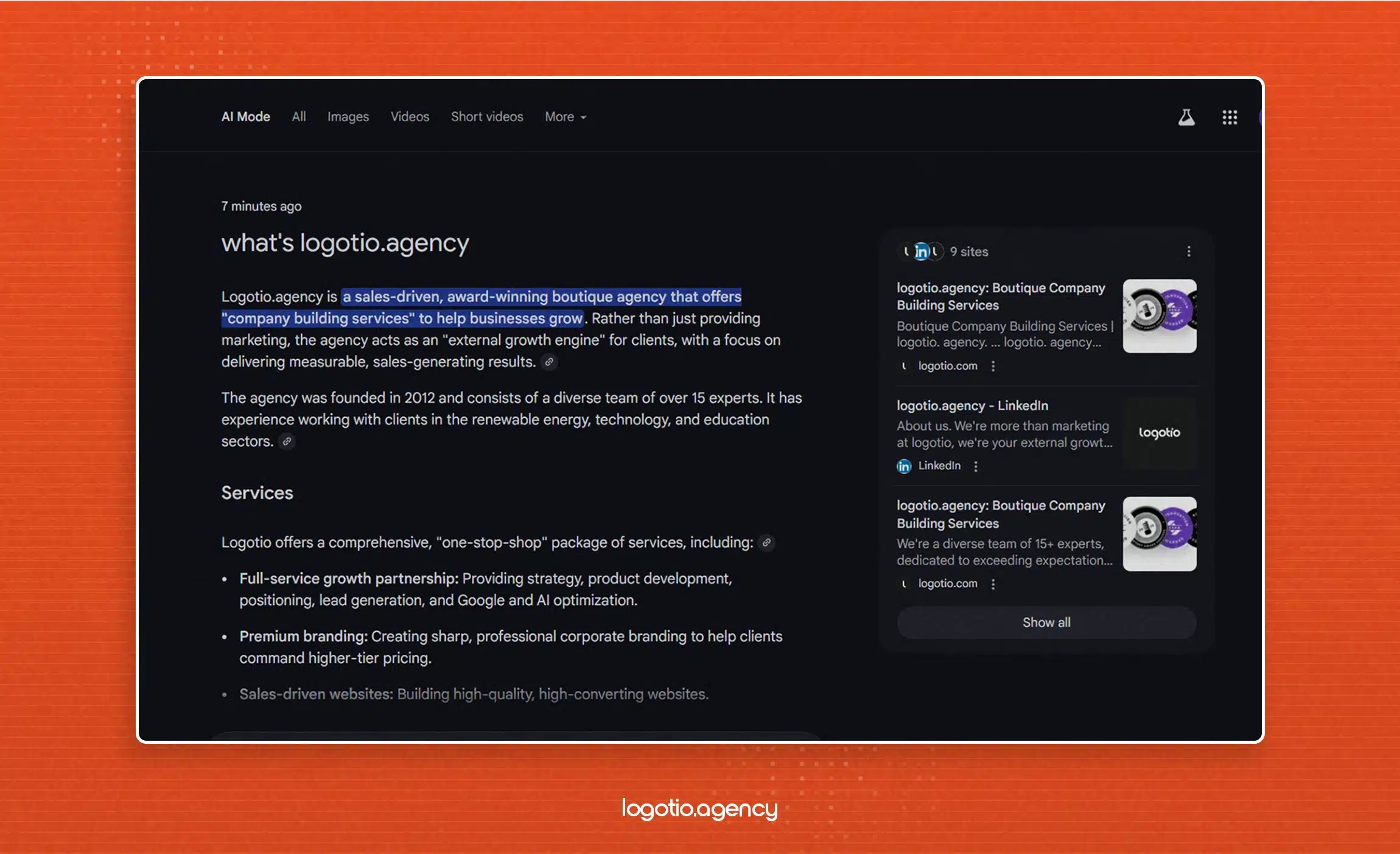
Also, with the heavy use of ChatGPT and similar tools becoming a primary way people browse information worldwide, showing up in AI-driven results isn’t optional anymore; it’s where visibility is shifting.
With AI Overviews taking up to 40% of users’ screens, this pushes content ranking #1 down, reducing its possibility of getting clicks if it is not cited in the overview.
Unlike traditional SEO where users click through search results, AI search often delivers a “final answer” inside the search itself. That means your website must be written in a way that an AI can easily understand, extract, and trust enough to reference.
Google’s AI Overviews influence which brands show up in answer boxes and follow-up prompts. This is prime visibility for complex queries like “how does solar financing compare across regions?” or “best practices for wind farm maintenance.” If your brand is missing there, your competitor gets the authority boost instead.
Think of GEO/AIO as the next layer or advanced SEO. It’s not replacing it, but adding a new standard: building pages that an LLM can parse, summarize, and cite. The brands that adapt early will own the awareness, not just the click.
We’ve covered in depth how you can optimize your renewable energy website for AI here.
11. Should renewable energy companies run PPC if they’re investing in SEO?
Yes, you should run PPC alongside SEO because it helps you target high-intent search queries that can deliver an immediate lead flow of potential customers, while SEO compounds authority over time.
SEO is powerful for long-term growth, but ranking for competitive terms like “solar financing” or “battery storage solution” can take months.
PPC fills that gap; you can bid on those same keywords today and start getting leads tomorrow.
Also, PPC is a great testing ground. You can use it to A/B test your landing page copy, offers, and structure quickly to see what resonates.
Beyond that, PPC data helps you identify which keywords drive the most clicks and conversions insights you can feed directly into your SEO strategy to rank for terms that already prove profitable.
Those insights can give you a blueprint for SEO to avoid guesswork.
The smartest play isn’t SEO or PPC; it’s pairing them together.
SEO compounds over time; PPC keeps the pipeline moving now.
Use PPC to target high-intent search queries, meet immediate demand, and A/B test landing pages while SEO compounds authority over time.
12. How can renewable energy companies create engaging educational content?
You can do this by making complex ideas simple through the use of clear terms, visuals, and storytelling tied to real-world results.
Most of your target audience won’t sit through a 20-page article full of jargon, but they will watch a 2-minute video explaining how storage cuts demand charges, or a case study on how you helped a brand reduce its electricity bill by 60%.
The secret is packaging knowledge in ways that answer their questions quickly and show clear outcomes. Use diagrams, step-by-step explainers, project examples, and simple tools.
When people understand not just what renewable energy is, but what it means for them, they stay engaged. And when they stay engaged, they trust you more; and that trust is what gets you loyal customers.
13. How do you become a thought leader in the clean energy space?
To become a thought leader, start by positioning your brand correctly and sharing real insights and data people can’t find anywhere else.
Decision-makers are flooded with generic “green future” talk. What gets their attention is specifics: the actual interconnection delays your clients faced, the ROI ranges for commercial solar, or the policy changes that affect local projects. That kind of content shows you’re not just talking; you’re in the trenches.
Consistency matters, too. A single article won’t build authority, but regularly publishing useful, evidence-backed insights will. Pair that with smart distribution: LinkedIn posts, industry blogs, and events.
Suddenly, your brand won’t be “another company in clean energy,” but the voice people look up to when they want the truth.
14. How can webinars, case studies, and reports boost renewable energy sales?
Webinars, case studies, and reports drive sales when you treat them as proof, not just content.
Here’s how it works:
Webinars are perfect for showing you understand your target audience’s pain points. Pick one big issue (like financing or interconnection) and walk them through it—this gives room for questions and answers.
Case studies prove results with numbers through past customers’ stories. State the problem, what you did, and the exact outcome: payback period, savings, or reliability.
Reports give you credibility. Even a short market insight report makes you look like the expert people want to partner with.
The key is to connect each piece back to the buyer’s journey.
Webinars capture interest, case studies build trust, and reports expand reach. Together, they move people from curious to convinced.
15. How do you balance technical details with storytelling in marketing?
You do this by translating the technical details into real-world impact.
Your audience doesn’t care about the kilowatt-hour rating of a panel; they care about what it means: lower bills, better reliability, cleaner air.
Technical terms prove credibility, but they need to be wrapped in stories people relate to.
The formula is simple:
Problem → Technical Solution → Human Outcome.
For example, we published a case study on how we helped one of our green energy clients 10× their sales and earn global recognition without the use of web or marketing jargon.
That’s technical truth wrapped in human relevance. That’s what sticks.
16. What role does LinkedIn really play in renewable energy marketing?
LinkedIn is where your buyers are, and it’s where authority is built for decision makers.
Whether you’re talking to investors, policymakers, or B2B partners, LinkedIn is the one platform they all use professionally.
Posting regular insights, case studies, and even short videos puts your brand in their feed.
Over time, that visibility builds familiarity and familiarity builds trust.
But it’s not just about posting. The bigger play is interaction: comment on industry news, join discussions, share perspectives, and network.
17. Is video marketing worth the investment for renewable energy firms?
Yes, because nothing builds trust faster than seeing and hearing your equity story.
Videos let you show proof in ways text can’t. A 90-second walkthrough of a solar farm speaks louder than a 5-page brochure.
Customer interviews put a human face on your results. Animated explainers make technical ideas like storage or grid integration simple to grasp.
And here’s the kicker: video content works everywhere. Chop it up for LinkedIn, embed it on your website, run it in your ads, or use it in investor decks. One shoot can fuel months of marketing.
This makes video an A+ trust multiplier.
18. How do you measure success in renewable energy marketing campaigns?
You measure success by leads and deals against your total marketing spend.
It’s easy to get caught up in clicks, likes, or impressions. But in B2B renewable energy, what matters is pipeline growth.
The real KPIs are:
- Qualified leads generated
- Sales cycle shortened
- Cost per lead reduced
- Deals influenced by marketing
Of course, visibility and awareness matter, but they’re only stepping stones. Success is when your brand activities directly contribute to revenue.
Every marketing dollar should deliver measurable ROI or it’s not working hard enough for you.
19. How do you overcome skepticism about renewable energy solutions?
You overcome skepticism with transparency, proof and clear guarantees.
Certifications are a starting point, but your market needs more than logos on a brochure or a website. They want evidence.
That means sharing independent performance data, publishing case studies with measurable before-and-after results, and directly tackling myths and objections in your content (for example, clarifying that solar panels still generate electricity on cloudy days).
Guarantees also reduce risk, such as a 90-day money-back offer or performance warranties that prove confidence in your solution.
Transparency pays off: 76% of consumers trust brands more when they share performance metrics openly (NielsenIQ, 2023).
When you make your data public and speak plainly, skepticism fades and trust builds faster.
20. How can you market renewable energy in a competitive market?
The only way to stand out in a crowded clean energy space is through brand differentiation, not price wars.
That means starting with strong branding and clear messaging so your audience knows exactly why your solution is different.
Next, you’ll want to build authority by publishing thought-leadership content, speaking at industry events, and securing PR placements in reputable outlets.
Value-add services are another way to rise above the noise. Offering things like free energy audits, financing support, or educational workshops gives prospects more reasons to choose you over a competitor.
The companies that win are the ones that lead with expertise, credibility, and quality of service, not just lower prices. That’s how you claim market share and own it.
At logotio.agency, we support renewable energy companies with branding and marketing that drive real results.
With over 12 years of experience, we’ve seen both the challenges and the opportunities in this space.
We understand how your audience makes decisions, and we handle the heavy lifting from branding and sales-driven websites to SEO, AI optimization, and complete marketing strategies, so you can focus on growth while getting the best return on your investment.