Technology companies operate in markets where the product is complex to communicate, multiple stakeholders, and the wrong marketing partner quietly drains both budget and credibility.
Specialized B2B tech marketing goes beyond ads and content. It requires precise positioning, a deep understanding of your buyers, and a growth engine built around how technical decision-makers actually evaluate and purchase.
At logotio.agency, we have spent over a decade helping technology and science-led businesses turn sophisticated offerings into measurable revenue.
This guide walks through why generic marketing fails for tech companies, what a specialized agency should deliver, and how to choose a partner who will generate pipeline.
Key Takeaway
- Generic marketing fails B2B tech companies because it ignores potential buyers’ complexity and long sales cycles.
- Positioning and messaging are the highest-leverage investments a tech company can make in marketing.
- A specialist agency understands regulatory, cultural, and buyer dynamics that generalists miss.
- SEO and AI search visibility are essential for gaining inbound leads.
- The best agencies measure success in pipeline contribution and revenue, not just follower counts or impressions.
- Our case studies below show what results look like when strategy, design, and execution align.
Why most B2B technology companies struggle to market effectively
The gap between how a company describes its solution and how a buyer perceives value is where most growth stalls.
Common reasons include:
Product-first messaging:
Leading with features, specs, and architecture instead of the problems your product solves. Most buyers want to understand what changes for them, not how the technology works underneath.
Weak positioning:
This means failing to communicate your product value in terms your non-technical buyers can act on. If a prospect cannot quickly understand what makes you different and what you stand for, your positioning is already costing you deals.
Misunderstanding customer pain points:
Most marketing addresses surface-level symptoms rather than the strategic, operational, or financial pressures that drive a purchase decision.
Ignoring technical audiences:
Assuming engineers and IT leaders make decisions on logic alone. In reality, even technical buyers are strongly influenced by trust, clarity, and perceived reliability before they can justify a decision internally.
Lack of differentiation:
Competing on features alone commoditizes your product and undermines your value, pushing every sales conversation toward price rather than values and problem solved.
Lack of industry expertise:
Generic agency playbooks applied to sectors like biotech, clean energy, or SaaS rarely account for the regulatory, cultural, and buyer dynamics that define those markets.
Misaligned content strategies:
Producing content that answers questions nobody is searching for, and missing the intent signals that indicate a buyer is actively evaluating solutions.
Each of these issues compounds the others, creating a marketing program that burns budget while failing to generate qualified pipeline.
Reasons why technology companies need specialized marketing
Selling complex B2B technology is fundamentally different from selling consumer goods or low-consideration services. The dynamics that define tech marketing include:

Longer buying cycles:
Deals often span six to eighteen months, requiring marketing that sustains engagement and builds trust across a long decision window.
Multiple decision-makers:
A typical B2B tech purchase involves a buying committee: the end-user, the technical evaluator, the budget holder, and often a procurement or compliance stakeholder. Each needs to be addressed with relevant messaging.
Technical products and services:
A tech product requires a marketing partner who understands the technology well enough to translate it into clear, outcome-focused communication without dumbing it down.
Trust-driven purchasing:
A technology investment carries significant risk for the buyer’s career and company. Marketing must reduce perceived risk through evidence, social proof, and brand authority.
High customer acquisition costs:
Inefficient marketing in this space erodes margin quickly. Precision targeting, message alignment, and conversion optimization are not luxuries. They are cost-control mechanisms.
A generalist marketing agency may deliver tactics. A specialized technology B2B marketing agency understands these dynamics from experience and builds programs designed for the environment your buyers live in.
What services should a technology B2B marketing agency offer?
A complete partnership should cover the full arc from strategic foundation to measurable demand generation. The following services form the core of a serious engagement.
Brand positioning
A specialized agency starts by defining your distinct market position, the audience you exist to serve, and the promise that makes you the obvious choice. Without this, every other marketing activity operates without a compass.
Messaging and value proposition
Translating technical capability into outcome-oriented language that resonates with each sector of your target audience. This includes crafting the core narrative, elevator pitch, and supporting proof points.
Website strategy and conversion optimization
Your website is the central hub where technical credibility meets commercial intent.
It must load fast, present information clearly, guide visitors toward a conversion event, and visually reflect the quality of your product.
A poorly designed website undermines even the best demand generation campaigns.
SEO and AI search optimization
Organic search is the most sustainable source of high-intent leads for B2B technology companies in the long run. With the rise of AI-powered search experiences, appearing in both traditional search results and AI-generated answers is essential.
A specialized agency ensures your content is structured, authoritative, and optimized for both human decision-makers and AI discovery models.
Why SEO and AI search optimization are essential for technology companies
Buyers begin their research long before they contact a vendor. When a potential client searches for a solution to a problem you solve, your brand needs to appear.
AI-powered search engines synthesize answers from multiple sources. When your content is authoritative and well-structured, it gets surfaced in those responses, giving you presence at the very beginning of the buyer’s journey.
Content marketing
Research-backed, human-written content that demonstrates expertise and answers the specific questions your buyers ask at each stage of their journey.
This includes blog posts, white papers, case studies, technical guides, and video content.
Well-structured, expert content also increases the likelihood of AI models recommending your brand when buyers search for solutions in your category.
Demand generation
Building and executing campaigns that create qualified leads. This includes lead magnet development, email nurture sequences, webinar programs, and content offers designed to convert anonymous visitors into known leads.
Account-Based Marketing (ABM)
Targeting specific high-value accounts with personalized marketing campaigns.
For tech companies with a clearly defined list of high-value target accounts, ABM aligns marketing and sales around the same priorities and significantly improves engagement rates.
Paid media
Strategically deployed search, social, and display advertising that target buyers actively in-market and reinforces brand presence. Paid media accelerates what organic efforts build over time.
Marketing automation
Implementing and optimizing the systems that manage lead scoring, email nurturing, and lifecycle communication. Marketing automation ensures that no lead falls through the cracks and every prospect receives relevant communication at the right time.
Analytics and reporting
Transparent measurement that connects marketing activity to revenue outcomes. Pipeline contribution, lead quality, cost per qualified opportunity, and attribution data are the metrics that matter, not follower counts.
B2B Tech client case studies
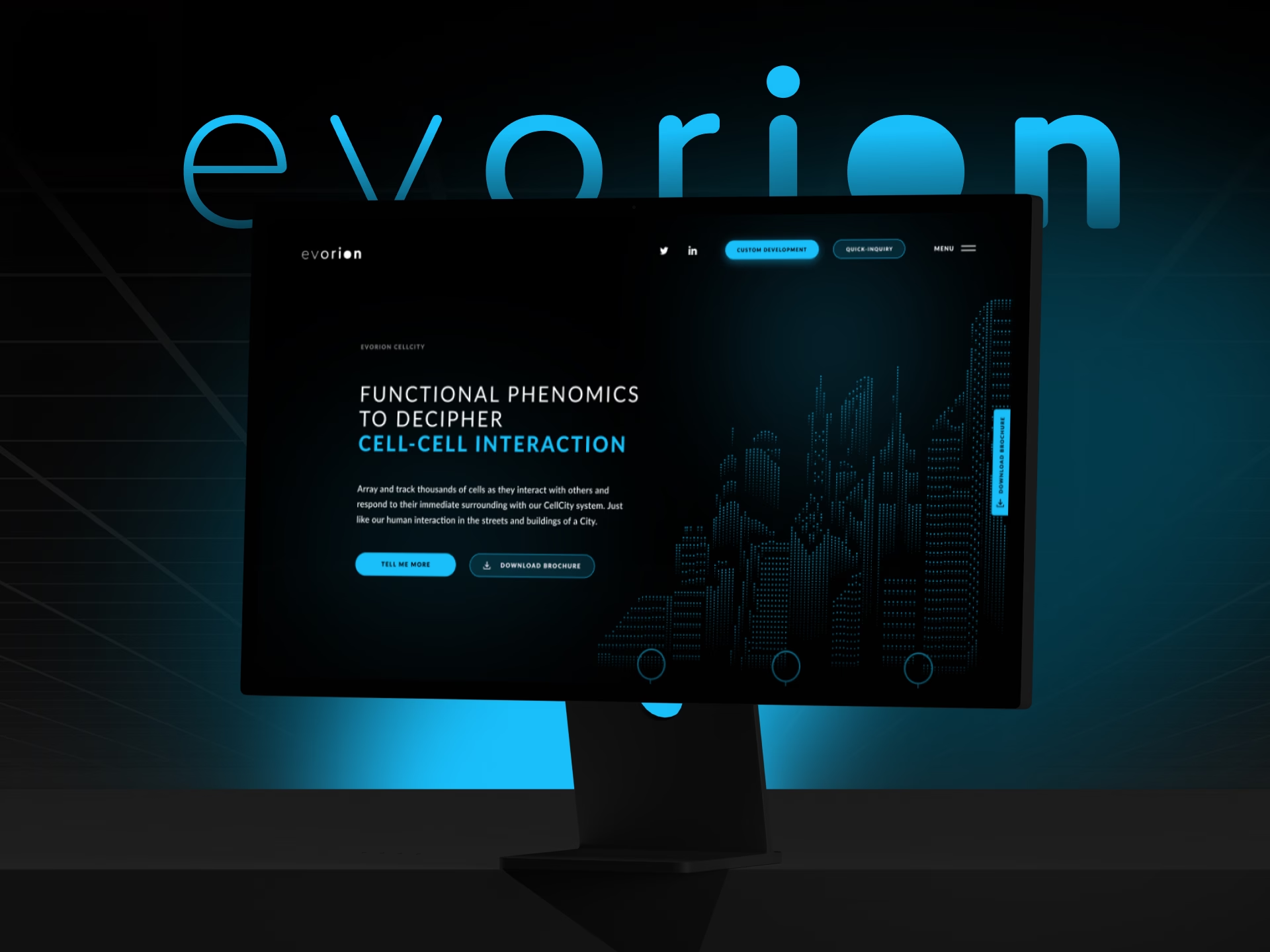
evorion biotech
evorion was a science startup transitioning into a professional biotech company. Their cell-analysis technology was advanced, but the market perceived them as a small lab.
We repositioned the brand from “innovative science project” to “trusted partner for global research institutions.”
The rebrand included strategic messaging, a complete visual identity system, a conversion-focused website with motion design, and a lead-generation infrastructure.
Within weeks, large companies and investors were approaching their leadership directly, describing Evorion as a credible and professional organization.
Tasa:
Tasa is a visual task management mobile application designed for frontline teams who need clarity and simplicity in their mode of operation.
What began as an internal prototype, designed and developed by the Logotio team, went on to become an award-winning product.
Building Tasa from the ground up gave us firsthand experience in product design, user experience, and the realities of bringing a technology product to market.
What we learned from that journey informs every client project we take on, ensuring our marketing strategies are grounded in product reality, not just theory.

Both cases demonstrate the same principle: technology marketing succeeds when strategy, design, and execution are built around the specific dynamics of B2B buying behaviour.
Most technology marketing fails because it leads with features instead of value.
If your pipeline isn’t reflecting the quality of your product, the issue is rarely the technology. It’s the story around it.
Let’s discuss your positioning and growth strategy.
Understanding the B2B Tech Buyer’s Journey
The buyer journey for a technology product unfolds across distinct stages, and effective marketing addresses each one with the right message at the right moment.

Awareness stage:
The buyer recognizes a problem or opportunity but has not yet clearly defined it. They search broadly, consume industry content, and look for frameworks to understand what they are dealing with.
Problem identification:
At this stage, the challenge is clearly defined. The buyer seeks educational content that validates their problem and explores potential approaches to solving it.
Solution research:
The buyer investigates categories of solutions. They compare solutions, read analyst reports, and look for credible voices in the space.
Vendor comparison:
At this stage, the shortlist begins. The buyer reads case studies and evaluates the perceived trustworthiness of each provider.
Internal stakeholder approval:
The buyer builds consensus within their organization. Marketing assets that support internal selling, such as ROI calculators and executive summaries, become critical.
Purchase decision:
The final evaluation. The vendor who has built the strongest combination of trust, clarity, and evidence wins.
A technology B2B marketing agency designs content and campaigns to address every stage of this journey, so that when the buyer is ready to decide, your brand is already the trusted option
How to choose the right B2B tech marketing agency
Evaluating agencies requires looking beyond case study, logos and polished proposals. The right partner demonstrates depth in several specific areas:
Industry expertise
Have they worked with companies in your sector or adjacent high-trust industries?
An agency that has marketed biotech instrumentation understands the regulatory and scientific context of your market.
An agency that has grown a tech product understands product-led growth and freemium conversion. Relevant experience shortens the learning curve and sharpens the strategy from day one.
Strategic capabilities
A serious partner asks diagnostic questions about your business model and buyer psychology, and measures success by revenue outcomes rather than vanity metrics.
Technical understanding
Can the agency grasp the technology you sell well enough to translate it into compelling messaging? This does not mean they need PhDs. It means they ask the right questions, learn quickly, and accurately communicate complex ideas.
Demand generation experience
Look for specific, documented results in generating qualified pipeline for B2B technology companies. Ask about the metrics they track, the campaigns they have run, and the attribution models they use.
Content quality
Review the agency’s own content and the content they have produced for clients. Is it thoughtful, well-written, and strategically sound? The standard of their own content is a reliable proxy for what they will produce for you.
Reporting transparency
A trustworthy agency connects marketing activity to sales outcomes and is open about what is working and what needs adjustment.
What to expect from a technology B2B marketing engagement
A serious engagement does not begin with a campaign. It begins with a diagnostic.
The first weeks involve reviewing your current positioning, understanding your sales cycle, mapping your buyers, and identifying where the biggest gaps between perception and reality exist.
From there, the agency builds a strategy. Messaging is defined, channels are selected based on the platform your buyers engage the most and content is mapped to each stage of the buying journey.
Execution follows strategy, not the other way around. You should expect regular reporting that connects activity to pipeline, honest conversations about what is and is not working, and a partner who adjusts based on data rather than defending a plan that is not performing.
At logotio.agency, every engagement starts with a brand and market audit so that the strategy we build is grounded in how your buyers currently see you, and where the opportunity to shift that perception is greatest.
Most technology marketing fails because it leads with features instead of value.
If your pipeline isn’t reflecting the quality of your product, the issue is rarely the technology. It’s the story around it.
Let’s discuss your positioning and growth strategy.
FAQs about B2B tech marketing agency
How much does a technology B2B marketing agency cost?
Ongoing marketing retainers start at $2,500 per month, covering demand generation, content marketing, and SEO. Scope is customized based on your growth goals and the competitive intensity of your market.
Before any campaign begins, we evaluate your current brand positioning to confirm it is strong enough to support your commercial targets. If it is not, we will tell you directly and recommend the right starting point.
What role does content marketing play in B2B technology sales?
Content marketing is the engine that builds authority, educates your buyers, and generates consistent demand. For complex technology products, research-backed content that matches buyer intent is often the primary driver of qualified inbound leads.
How do you measure marketing success for B2B technology company campaigns?
Success is measured in pipeline contribution: qualified leads generated, opportunities created, cost per opportunity, and conversion rates at each funnel stage. Revenue influence is the ultimate measure, and it is how we evaluate every engagement.
What marketing channels work best for technology companies?
The mix depends on your target market. SEO and organic content perform well for most B2B tech firms because buyers research extensively before contacting vendors.
LinkedIn advertising, targeted ABM, and email nurture are also effective.
The key is to be present where your specific buyer spends their attention and to deliver messaging that matches their stage of the journey.
What is the best B2B tech marketing agency for a growing company?
The best agency is one that combines strategic depth, relevant industry experience, and the ability to connect marketing activity to revenue.
At logotio.agency, we focus deliberately on technology, education, and science-led businesses. With over a decade of experience and a 93% client retention rate, we treat marketing as a growth function that pays for itself.